
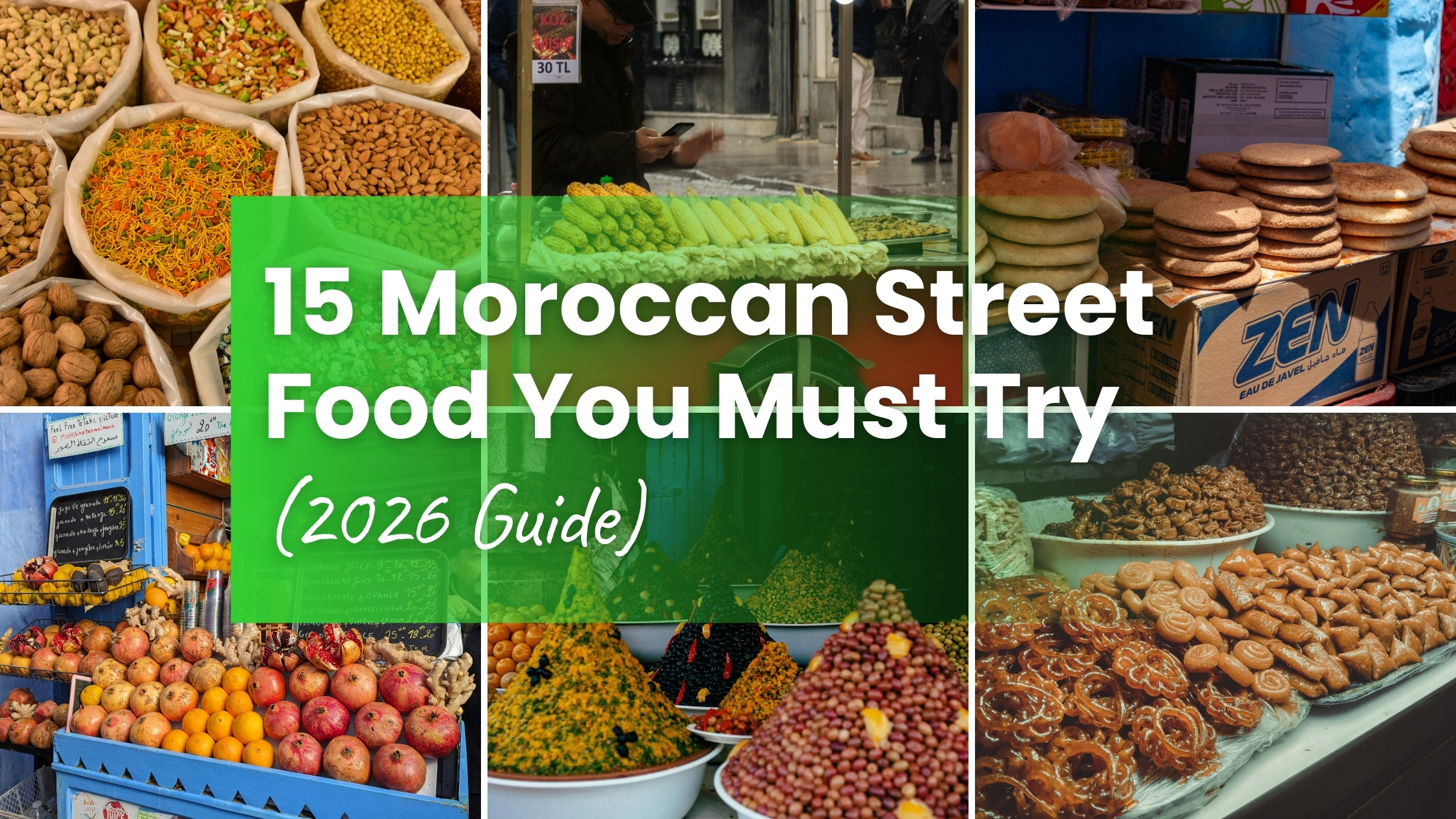
There is a particular kind of eating that only happens in certain places in the world — outside, standing up, surrounded by smoke and noise and the smell of charcoal and cumin, paying almost nothing and receiving something extraordinary. Moroccan street food is that kind of eating. It is among the most varied, most flavourful, and most historically layered street food traditions in the world, and it has been largely invisible to the global food conversation for far too long.
I have been eating Moroccan street food for over a decade — from the legendary food stalls of Djemaa el-Fna in Marrakech to the morning bissara carts of Fez’s medina, from the merguez grills of Casablanca’s working-class neighbourhoods to the msemen women who set up at dawn on the back streets of Meknes and are sold out by 9:00 AM. What I can tell you plainly is this: the street food in Morocco is not a simplified or budget version of the country’s cuisine. It is the cuisine — the original, living, daily expression of how Moroccans actually eat.
This guide covers 15 essential Moroccan street food dishes you need to try, with honest descriptions, specific locations, prices in dirhams, and the practical details that make the difference between a confident street food adventure and a hesitant tourist meal. Whether you are spending three days in Marrakech or three weeks crossing the country, this is your complete guide to Morocco’s street food scene.
Why Moroccan Street Food Is in a League of Its Own
To understand why Moroccan street food occupies a special position in the global street food landscape, you need to understand the culinary history behind it. Morocco sits at the intersection of Amazigh (Berber) indigenous food culture, Arab culinary tradition brought with the 7th-century Islamic expansion, Andalusian flavours carried by refugees expelled from Spain in 1492, sub-Saharan African spice routes, and a French and Spanish colonial period that left its own marks on the bread, patisserie, and cafe culture. Every bowl of Moroccan street food you eat carries that layered history in some form.
The spice tradition alone sets Moroccan street food apart. Ras el hanout — a complex blend that can contain anywhere from 10 to 30 individual spices — features in everything from grilled kefta to slow-cooked snail broth. Cumin, paprika, coriander, turmeric, ginger, and saffron are not exotic flourishes in Moroccan street food; they are everyday staples as fundamental as salt. The result is a flavour profile that is simultaneously warm, fragrant, complex, and deeply satisfying in a way that straightforward chilli-heat street food traditions simply cannot match.
The social architecture of Moroccan street food is also distinctive. The great squares and medina alleyways of Morocco’s imperial cities are not just food markets — they are the stage for an entire urban food culture that has been operating continuously for centuries. Djemaa el-Fna in Marrakech has been a street food venue since at least the 11th century. The morning bissara cart at the entrance to a Fez derb (alleyway) has probably occupied roughly the same spot in various forms since the Marinid dynasty. Eating Moroccan street food is participation in a living cultural tradition, not just a meal.
| Dish | Type | Best City | Price (MAD) | When |
| Msemen | Flatbread | Nationwide | 2-5 | Morning |
| Harira | Soup | Nationwide | 5-10 | Evening |
| Merguez | Grilled meat | Marrakech / Fez | 10-20 | Lunch/Dinner |
| Bissara | Soup | Fez / Meknes | 5-8 | Morning |
| Kefta Brochette | Grilled meat | Marrakech | 10-20 | Lunch/Dinner |
| Makouda | Fried potato | Fez / Casablanca | 5-10 | Anytime |
| Sfenj | Doughnut | Nationwide | 1-2 | Morning |
| Snails (Ghlal) | Snail broth | Marrakech | 5-10 | Evening |
| B’stilla | Pastry | Fez / Marrakech | 15-25 | Lunch |
| Kefta Sandwich | Sandwich | Nationwide | 10-15 | Anytime |
| Chebakia | Sweet pastry | Nationwide | 2-5 | Ramadan/Year |
| Rghaif | Stuffed pancake | North Morocco | 5-10 | Morning |
| Maakouda Sandwich | Fritter bun | Fez / Rabat | 5-10 | Lunch |
| Grilled Corn | Snack | Coastal cities | 3-5 | Summer |
| Orange Juice | Drink | Marrakech | 4–7 | Anytime |
1. Msemen — The Flaky Flatbread at the Heart of Moroccan Street Food
If there is a single food that defines the daily rhythm of Moroccan street food more than any other, it is msemen. A square, multi-layered flatbread made from semolina and plain flour, folded and refolded before being cooked on a dry griddle until the outside is crisp and the inside pulls apart in papery, buttery sheets — msemen is the bread Morocco wakes up to every morning. You will find it being made and sold from small street carts, from the windows of tiny hole-in-the-wall bakeries, and from folding tables set up by women on residential street corners from Tangier to Taroudant.
The Moroccan street food stall making msemen is one of the most satisfying food sights in the country: the maker working rapidly, folding and pressing the dough into squares with practised efficiency, the griddle smoking, a small queue of customers waiting with their dirham coins ready. Msemen is eaten with honey and argan oil for breakfast, with soft white cheese (jben) as a snack, and — in its rghaif variation stuffed with spiced onion and beef — as a full street meal in its own right.
What It Is
A laminated flatbread, similar in technique to Yemeni malooga or Indian paratha, made by stretching dough thin, coating with butter and semolina, and folding repeatedly before griddle-cooking. The resulting bread is simultaneously crisp and chewy, with distinct layers that tear apart when pulled. A defining element of Moroccan street food culture and one of the country’s truly essential daily foods.
Where to Find It
Everywhere — but the best msemen in Morocco comes from neighbourhood street carts in residential medina quarters rather than tourist-facing cafes. In Marrakech, look in the Mellah and the streets around Bab Doukkala. In Fez, the area around Bab Bou Jeloud has excellent msemen vendors from 7:00 AM. In Meknes, the women selling msemen near the medina entrance are a Moroccan street food institution.
What It Costs
2–5 MAD per piece from a street cart. Served with honey and butter, a full msemen breakfast at a street stall costs 10–15 MAD. One of the greatest value-per-dirham exchanges in all of Moroccan street food.
2. Harira — Morocco’s Soul in a Bowl
Harira is the soup that holds Moroccan street food culture together. A rich, tomato-based broth thickened with flour and lemon, packed with chickpeas, lentils, vermicelli, fresh coriander, and celery, and seasoned with ginger, turmeric, cinnamon, and ras el hanout — it is a complete meal in a bowl, warming, sustaining, and more complex in flavour than any description fully captures. Harira is the soup Moroccan families break the Ramadan fast with every evening, the bowl sold from steaming pots at the entrances to medinas across the country from dusk onwards, and the street food in Morocco most frequently praised by international visitors who try it for the first time.
The experience of eating harira as Moroccan street food is specific: a low plastic stool at a folding table, a deep terracotta bowl ladled from a large clay pot, a piece of khobz bread on the side, and a small plate of dates and chebakia sweet pastry if you are eating at the traditional iftar hour. The whole arrangement costs around 10–15 MAD and represents one of the genuinely great cheap meals anywhere in the world.
What It Is
A slow-cooked tomato and lemon broth thickened with flour (the technique is called tadouira), enriched with pulses and vermicelli, and finished with a substantial handful of fresh coriander and parsley. The flavour profile is simultaneously tangy, warming, and deeply savoury. Harira is the most emotionally significant single dish in Moroccan food culture — it is the food of homecoming, of fasting broken, of family gathered. Eating it as Moroccan street food is eating it in its most honest context.
Where to Find It
All over Morocco, but best experienced at the open-air soup kitchens around Djemaa el-Fna in Marrakech from sundown, at the medina gate carts in Fez, and from the street stalls around the Hassan II Mosque in Casablanca. During Ramadan, harira street food stalls appear on virtually every significant corner in every Moroccan city about 30 minutes before the call to prayer.
When to Eat It
Harira is traditionally an evening street food in Morocco, though you will find it served at lunchtime in traditional restaurants. The best street harira is sold from stalls that have been simmering the same pot all day — look for the vendors with the largest queues and the oldest, most seasoned clay pots.
3. Merguez — The Street Grill That Defines Moroccan Street Food
If Moroccan street food had an ambassador, it would be the merguez — the slender, fiery, deep-red lamb and beef sausage that perfumes every major street food market in Morocco with its combination of charcoal smoke, cumin, harissa, and rendered fat. Merguez is North African in origin and has spread across the Mediterranean and into French cuisine (where it is ubiquitous at summer barbecues), but no version anywhere compares to eating it fresh off a Moroccan street grill — charred and splitting on the outside, juicy and intensely spiced within, wrapped in a piece of soft khobz bread and handed to you on a square of paper.
The street food merguez experience in Morocco is anchored in the great grill markets: the numbered stalls of Djemaa el-Fna, the alleyway grills outside the tanneries in Fez, the beachside merguez carts of Essaouira and Agadir. Each location has its own character, but the fundamental transaction is the same everywhere: you point, the vendor grills, you eat standing up or perched on a low stool, and the whole thing costs less than a cappuccino in any European city.
What It Is
A thin, long sausage made from minced lamb and beef, heavily spiced with cumin, paprika, garlic, harissa, and coriander seed, stuffed into natural casing and grilled over charcoal. The name derives from the Amazigh word amrguez. It is one of the foundational elements of Moroccan street food and the grill tradition that sits at the centre of Moroccan outdoor cooking culture.
Where to Find It
The numbered grill stalls at Djemaa el-Fna in Marrakech are the most theatrical merguez street food experience in Morocco — competitive, noisy, and genuinely delicious. Stall number choice matters: look for vendors with the shortest queues relative to the volume of smoke coming from their grill, which indicates fresh stock being cooked continuously. In Fez, the grills near Bab Bou Jeloud serve excellent merguez from midday. In Casablanca, the Maarch neighbourhood has a serious street food merguez tradition.
Tips
Always check that the merguez is cooked through before eating — the inside should be fully firm with no pink when bitten. A fresh harissa sauce on the side is standard; ask for it if it is not offered. The best Moroccan street food merguez comes from vendors who make their own sausages rather than buying pre-made from a supplier — you can usually tell by whether the sausages are uniform and plastic-wrapped (bought in) or slightly irregular and freshly linked (made in-house).
4. Bissara — The Fava Bean Street Food of Morocco’s North
Bissara is the street food in Morocco that most visitors never try and virtually every Moroccan eats regularly. A thick, creamy puree of dried fava beans (or split peas) slowly cooked with garlic, olive oil, and cumin, then finished with a generous pour of Morocco’s finest argan or olive oil and a dusting of paprika and dried chilli — it is one of the great cheap-eat street foods of the Moroccan morning. In the medinas of Fez and Meknes especially, bissara carts set up before dawn and serve the first customers — builders, market porters, medina shopkeepers — from around 6:00 AM.
Bissara occupies a specific and important place in Morocco’s street food culture as a working-class breakfast food — the fuel that gets the medina moving before the tourist day begins. Eating it as Moroccan street food means showing up early, sitting at a shared table, dipping rough bread into a bowl that costs 5–8 MAD, and drinking it surrounded by people who have already done two hours of work by the time you arrived. It is one of the most authentic food experiences Morocco offers.
Where to Find It
Primarily in northern Morocco — Fez, Meknes, Tangier, Tetouan, and Chefchaouen. The street leading from Bab Bou Jeloud into the Fez medina has several excellent bissara carts. In Meknes, the area around the medina’s main gate serves outstanding bissara from early morning. Less common in Marrakech, where breakfast street food culture trends toward msemen and cafe au lait.
5. Kefta Brochettes — Spiced Minced Meat on the Moroccan Street Grill
Kefta brochettes — long, flat skewers of minced lamb or beef mixed with onion, parsley, coriander, cumin, paprika, and cinnamon, grilled over charcoal — are the other half of the Moroccan street food grill experience alongside merguez. Where merguez is fierce and fatty, kefta is subtler and more fragrant, with the herb and spice mixture giving it a complexity that rewards eating slowly.
Kefta is the Moroccan street food most closely replicated in European Moroccan restaurants, which means many visitors arrive thinking they know what it tastes like. They do not — the difference between kefta made fresh and grilled over real charcoal at a Moroccan street food stall and the version served in a London or Paris restaurant is the difference between live music and a recording.
Where to Find It
The same grill markets as merguez — Djemaa el-Fna in Marrakech is the most famous, but the street food grills of Fez’s Rcif square and Casablanca’s Boulevard Mohamed V area are excellent. Kefta is also a staple of the roadside grill stalls that appear along major Moroccan highways — the stops on the road between Marrakech and Agadir are particularly good.
Tips
Ask for your kefta brochettes with a side of grilled tomato and onion, which the stall vendor will have ready on the grill beside the meat. The combination of kefta, charred tomato, and fresh bread is one of the defining flavour combinations of Moroccan street food. A plate of four skewers with bread, salad, and a harissa dipping sauce costs 20–35 MAD at a street grill stall.
6. Makouda — Morocco’s Beloved Street Potato
Makouda (or maakouda) are small, round potato fritters — boiled potato mashed with garlic, parsley, cumin, and egg, formed into discs, coated in batter, and deep-fried until golden. They are crisp on the outside, fluffy and richly spiced within, and rank among the most universally loved of all Moroccan street food snacks. They are eaten on their own as a street snack, served in a bread roll as the famous maakouda sandwich (covered later in this guide), and appear at Moroccan street food stalls across the country from the Atlas Mountain villages to the Atlantic coast.
Makouda is the Moroccan street food that best illustrates the country’s genius for making simple ingredients exceptional through spicing and technique. There is nothing remotely exotic in the ingredient list — potato, egg, flour, parsley, cumin — but the result, fresh from the oil and eaten with a squeeze of harissa, is something that visitors frequently describe as one of the best things they ate in Morocco.
Where to Find It
Fez is arguably the makouda capital of Moroccan street food — the stalls around Bab Bou Jeloud and in the Rcif area fry them continuously from midday. Casablanca and Rabat both have strong makouda street food traditions. In Marrakech, look in the alleyways around the Mellah quarter rather than the main tourist streets.
7. Sfenj — The Moroccan Street Doughnut
Sfenj are Moroccan street food doughnuts — irregular, airy rings of yeasted dough fried in hot oil until puffed and golden, then threaded onto a piece of palm leaf or straw and handed to you immediately, still hot and glistening. They are sold exclusively in the morning, exclusively from dedicated sfenj carts or street fryers, and eaten with mint tea, coffee, or simply on their own as a wake-up sugar hit.
The sfenj fryer is one of the most distinctive figures in Morocco’s street food culture: working at speed, pulling fresh dough from a large shared bowl, stretching it into rough rings, and dropping them into smoking oil with the efficiency of long practice.
Unlike European doughnuts, sfenj are not glazed, filled, or dusted with sugar as standard — they are eaten plain, which throws the flavour of the yeasted dough itself into prominence. Some vendors offer them with honey or powdered sugar, which is excellent. But the purist street food in Morocco version — plain, hot, eaten standing at the cart — is the right way to eat them.
Where to Find It
Sfenj carts set up in the early morning at medina entrances, near market squares, and outside mosques after the fajr (dawn) prayer across Morocco. In Marrakech, the Mellah square has reliable sfenj vendors from around 7:00 AM. In Fez, the area around the Qarawiyyin mosque vicinity has several. Sfenj are a morning-only Moroccan street food — by 10:00 or 11:00 AM, the carts are typically sold out and gone.
Pro Tip: Sfenj are best eaten within five minutes of coming out of the oil. They become dense and chewy as they cool — unlike almost any other Moroccan street food, their entire appeal depends on immediacy.
8. Snails in Broth (Ghlal) — The Djemaa el-Fna Ritual
Of all the Moroccan street food experiences available in Marrakech, eating snails (ghlal in Darija) from the steaming pots of Djemaa el-Fna is the one that most clearly separates confident street food travellers from hesitant ones. Dozens of small, dark snails are slow-cooked in an aromatic broth seasoned with thyme, mint, ginger, liquorice root, anise, orange peel, and a dozen other herbs and spices — the exact recipe varies by vendor and is closely guarded. They are served in a small bowl with a toothpick for extraction and the instruction to drink the broth from the bowl when the snails are finished.
The broth is the point. Yes, the snails themselves are pleasant — mild, slightly chewy, absorbing the spice mixture they have been cooked in — but the deeply complex, aromatic liquid they swim in is one of the most distinctive flavour experiences in all of Morocco’s street food culture. It tastes like nothing else anywhere. The vendors who specialise in this Moroccan street food dish are a permanent fixture of Djemaa el-Fna, their pots continuously replenished, their shout of ‘ghlal! ghlal!’ audible across the square.
Should You Try It?
Yes, without hesitation. The snails are harmless, fully cooked, and mild enough to appeal to people who would never order escargot in a restaurant. The bigger barrier for most visitors is the unfamiliarity of the Djemaa el-Fna street food stall format — the aggressive tout culture, the cramped benches, the pressure to order more. Commit, sit down, order one bowl, drink the broth, and you will understand why this particular Moroccan street food has its own devoted following.
9. B’stilla — The Sweet-Savoury Pastry Marvel of Moroccan Street Food
B’stilla (also written pastilla or bastilla) is the dish that most dramatically illustrates the Andalusian thread running through Moroccan street food and restaurant culture. A crisp, paper-thin warka pastry shell filled with slow-cooked pigeon or chicken, egg, almonds, cinnamon, and saffron — then dusted on top with powdered sugar and cinnamon — it is simultaneously savoury and sweet, rich and flaky, warming and complex. It is one of the most technically demanding dishes in the Moroccan repertoire, which is why finding a genuinely good b’stilla street food version rather than a restaurant version represents a real discovery.
In Fez especially, small b’stilla vendors operate in the medina, selling individual hand-held portions of the pastry — street food in Morocco at its most refined. These are not the large banquet versions served at weddings; they are compact, self-contained individual pastries that allow you to eat one of Morocco’s most sophisticated dishes standing at a stall. The experience of biting through the sugar-dusted pastry crust into the warm pigeon-and-almond filling is one of the great Moroccan street food moments.
Where to Find It
The Fez medina is the spiritual home of b’stilla street food in Morocco. Look near the Bou Inania Madrasa and around the Rcif area for vendors selling individual portions. In Marrakech, several stalls in the Djemaa el-Fna food court area sell b’stilla alongside other Moroccan street food classics. Prices run 15–25 MAD for an individual portion.
10. The Moroccan Street Food Sandwich — Kefta or Merguez in Batbout Bread
If you visit Morocco and do not eat at least one street food sandwich, you have missed something essential. The Moroccan street sandwich — kefta or merguez grilled to order and tucked into a soft, round batbout bread (a Moroccan yeasted flatbread cooked in a dry pan) with harissa, chermoula sauce, and grilled tomato — is the everyday working lunch of the Moroccan street food scene. It is fast, portable, intensely flavoured, and costs 10–15 MAD. It is also, in my experience, one of the most satisfying meals available anywhere in Morocco at any price point.
The batbout bread is the key differentiator from other North African sandwich traditions. Softer and more absorbent than a baguette, it holds the meat juices and harissa without disintegrating, creating a structural and flavour harmony that is central to the Moroccan street food sandwich experience. Some vendors add processed cheese, a fried egg, or tinned sardines to create more elaborate combinations — all of them worth trying.
Where to Find It
Everywhere. The Moroccan street food sandwich is the most geographically consistent item on this list — you will find excellent versions in every city, every medina, and most roadside stops across the country. In Marrakech, the sandwich vendors around Bab Agnaou and near the Koutoubia mosque are reliable. In Casablanca, the area around the central market has a cluster of outstanding sandwich stalls. In Fez, look near Bab Bou Jeloud.
11. Chebakia — The Honey-Sesame Sweet of Moroccan Street Food
Chebakia are flower-shaped fried pastries coated in warm honey and rolled in sesame seeds — one of the most emblematic sweet street foods in Morocco and, during Ramadan, as omnipresent as harira soup. Made by shaping strips of spiced, rose water-scented dough into intricate flower forms, frying them in oil, then submerging them in honey before pressing on toasted sesame seeds, they are sticky, sweet, fragrant, and intensely calorie-dense. They are the street food in Morocco that children reach for first and adults return to repeatedly, and they represent the pastry tradition at the heart of Moroccan sweet food culture.
Outside Ramadan, chebakia are available year-round at patisseries and from specialist street food vendors, particularly around religious festivals and celebration days. During Ramadan, they are practically inescapable — piled in pyramids at every street stall, sold by the kilogram to families preparing for iftar, and eaten alongside harira soup as the traditional fast-breaking combination.
When to Find It
Year-round at specialist Moroccan pastry shops, but at their absolute finest during Ramadan when they are freshly made daily at street stalls across the country. The best chebakia in Moroccan street food culture come from the small family-run pastry workshops in the Fez and Meknes medinas that have been making them for generations.
12. Rghaif — The Stuffed Savoury Pancake
Rghaif is msemen’s more substantial cousin — a larger, thicker version of the layered flatbread stuffed with a filling of spiced minced beef or lamb, onion, and parsley before being folded and griddle-cooked. It is one of the most filling Moroccan street food items available and represents a full meal in hand for 8–12 MAD. The filling is incorporated into the dough layers as it cooks, creating a unified structure rather than a pocket — the flavours meld completely, the fat from the meat rendering into the dough layers and giving them a richness that plain msemen lacks.
Rghaif is particularly associated with northern Morocco — Tangier, Tetouan, and Chefchaouen have strong rghaif street food traditions, and the women who make and sell it in these cities are some of the most skilled bread-makers in the country. In the south, a similar stuffed flatbread called meloui (made with a slightly different folding technique producing a round, coil shape) plays the same role in the street food in Morocco landscape.
Where to Find It
The best rghaif Moroccan street food is found in northern Morocco — look at the morning market stalls in Tangier’s Grand Socco, in the medina of Tetouan (one of the best-preserved and least-touristed in Morocco), and at the small food stalls around Chefchaouen’s main square. Also available in Fez and Meknes, particularly in residential medina quarters.
13. The Maakouda Sandwich — Deep-Fried Potato in a Bread Roll
The maakouda sandwich deserves separate treatment from plain makouda because the combination — hot potato fritters tucked into a fresh khobz roll with harissa, olives, capers, and preserved lemon — is a Moroccan street food category unto itself. It is the street food in Morocco most frequently described by visitors from France and Spain as being better than anything comparable in their own countries’ street food traditions, and I think that assessment is correct. The contrast of textures — the crunch of the fritter against the soft bread, the heat against the acidic preserved lemon — is a masterwork of unconscious food engineering refined over generations of street food practice.
This Moroccan street food sandwich is the speciality of Fez and Rabat in particular, where dedicated maakouda sandwich vendors operate from the same spots every day, sometimes for decades. It is recognisable on sight: a small cart or window, a tray of freshly fried golden fritters, a pile of bread rolls, and a queue.
Where to Find It
Fez is the maakouda sandwich capital of Morocco’s street food scene — the stalls near Bab Bou Jeloud are the most accessible for visitors. In Rabat, the area around the medina entrance near the Hassan Tower has excellent vendors. The sandwich costs 5–10 MAD and is one of the best value Moroccan street food experiences on this list.
14. Grilled Corn — Simple, Seasonal, and Underrated
Grilled corn on the cob (draa in Darija) is among the most seasonal of all Moroccan street food items — available from summer through early autumn at coastal cities and mountain resort towns, and among the most aromatic street food experiences Morocco offers. The corn is grilled directly over charcoal embers on simple braziers, rubbed with a mixture of salt, cumin, and sometimes harissa butter, and served in the husk as a handle. It is eaten standing, one hand holding the husk, the other wiping juice from your chin.
Grilled corn street food in Morocco is at its best along the Atlantic coast — Essaouira, Agadir, El Jadida — and at mountain destinations like Ifrane and Ouirgane during summer weekends when Moroccan families escape the heat of the plains. It is simple, seasonal, and representative of the way Moroccan street food culture absorbs and refines even the most basic ingredients through the application of spice and live fire.
15. Freshly Squeezed Orange Juice — Marrakech’s Liquid Street Food Icon
Listing orange juice as a Moroccan street food item might seem indulgent, but anyone who has stood at one of the legendary juice stalls of Djemaa el-Fna on a warm afternoon and drunk a glass of freshly squeezed Moroccan oranges — thick, sweet, and cold from the press — will understand immediately why it belongs here. Morocco is one of the world’s largest orange producers; the Souss Valley south of Agadir supplies much of Europe with citrus, and the surplus flows directly into the street food juice culture of Marrakech’s great square.
The juice stalls of Djemaa el-Fna are one of the most iconic street food in Morocco images in existence: rows of orange pyramids, hand-operated presses, and glass after glass of vivid orange liquid dispensed at 4–7 MAD per glass. The haggling over price is part of the ritual; the first price offered is always higher than what you should pay. The juice itself, regardless of what you paid for it, is perfect.
Pro Tip: The freshly squeezed orange juice stalls on the north side of Djemaa el-Fna closest to the medina entrance are generally the busiest and highest-turnover, which means freshest fruit. Pay no more than 5–7 MAD per glass.
Where to Find the Best Moroccan Street Food by City
Marrakech — The Street Food Theatre
Marrakech is the world’s most famous stage for Moroccan street food, and Djemaa el-Fna is its centrepiece. The square transforms every evening from a modest daytime gathering into a full-scale open-air food market with over 100 individual stalls selling everything from harira and snails to merguez, kefta, b’stilla, and fresh orange juice.
For all its tourist-facing character, the street food at Djemaa el-Fna is genuinely good and the experience of eating there at night, surrounded by smoke and the sound of Gnawa musicians, is one of the great food theatre moments anywhere in the world. Beyond the square, the residential medina streets — particularly around Bab Doukkala, the Mellah, and Bab Agnaou — have a more authentic and less expensive Moroccan street food scene aimed entirely at locals.
Fez — The Intellectual Capital of Moroccan Street Food
Fez has the strongest and most historically layered street food culture in Morocco. The medina of Fez el-Bali — a UNESCO World Heritage Site and the world’s largest car-free urban area — has been fed by street vendors for over a thousand years, and the tradition is fully intact. Bab Bou Jeloud and the streets leading into the medina offer the densest concentration of Moroccan street food vendors anywhere in the country: bissara from 6:00 AM, msemen and sfenj through the morning, makouda and merguez at lunch, b’stilla and maakouda sandwiches in the afternoon, harira from dusk.
A single walk from Bab Bou Jeloud to the Qarawiyyin mosque area and back, stopping at street stalls along the way, constitutes one of the finest food experiences Morocco offers.
Casablanca — The Working City’s Street Food Scene
Casablanca’s street food in Morocco is less picturesque than Marrakech or Fez but arguably more honest — the food of a working city of five million people, practical, abundant, and priced for daily consumption. The Maarch neighbourhood, the area around the central market, and the Corniche seafood stalls all have excellent street food. Casablanca is also where you find the most interesting intersection between traditional Moroccan street food and modern food cart culture — the city has a growing scene of hybrid street food vendors combining Moroccan spicing with global formats.
Chefchaouen — Small City, Big Street Food Character
Chefchaouen’s street food scene is modest in scale but high in quality. The blue-painted streets of the medina contain a cluster of excellent street food spots around the main Uta el-Hammam square — msemen and rghaif vendors in the morning, grilled kefta and merguez in the evening, and some of the best fresh goat cheese (jben) street food in Morocco available from market stalls in the weekly souks. The mountain air at 600 metres elevation makes eating outdoors here particularly pleasant.
Meknes — The Underrated Street Food City
Meknes is the most underrated city on Morocco’s street food map, consistently overlooked in favour of its more famous neighbours Fez and Marrakech. Its medina has an outstanding morning street food scene — the bissara here is widely considered the best in Morocco, the msemen vendors are prolific and skilled, and the evening grill stalls around Place el-Hedim (the city’s answer to Djemaa el-Fna) are consistently excellent. For travellers who want authentic Moroccan street food without the tourist prices or crowds of the more famous cities, Meknes is the answer.
Moroccan Street Food Safety — Practical Tips
The question of street food safety in Morocco comes up frequently, and the honest answer is: eat confidently, but eat intelligently. Morocco has been developing its food safety and hygiene standards significantly over the past decade, and the risk of illness from street food in Morocco is considerably lower than visitors often fear. That said, a few practical principles apply:
Choose stalls with high turnover — the street food vendor with a queue is safer than the one sitting idle, because high turnover means fresh stock and continuously hot equipment
Avoid pre-cooked meat left out on display — kefta and merguez should be grilled to order in front of you, not sitting at room temperature on a tray
Eat your first day of Moroccan street food conservatively — give your digestive system time to adjust to the spice levels and different food bacteria profile before eating adventurously
Cooked food is safer than raw — harira, merguez, kefta, and msemen all involve sufficient heat to eliminate pathogens; fresh salads and fruit require more caution
Drink bottled water — tap water in Morocco’s cities is technically treated but can cause digestive upset in visitors unaccustomed to it; bottled water is cheap and universal
Trust your nose and eyes — Moroccan street food vendors who take pride in their product are obvious: clean equipment, organised stalls, fresh ingredients on display. This is the most reliable safety signal available.
How Much Does Moroccan Street Food Cost?
Moroccan street food is among the most affordable in the world. A full day of eating exclusively from street stalls — breakfast msemen and sfenj, a bissara or harira at lunch, merguez or kefta brochettes at dinner, snacks and a juice — costs approximately 60–100 MAD (roughly 6–10 USD or 5–8 EUR) per person. Individual items range from 1–2 MAD for a single sfenj to 25 MAD for a b’stilla portion, with most savoury street food dishes falling in the 5–15 MAD range.
Tourist-facing stalls in high-traffic areas like Djemaa el-Fna charge more than neighbourhood vendors — sometimes two or three times more for identical food. The practical response is to eat where locals eat, which usually means walking two or three streets away from the main tourist square and following the direction that most medina residents are walking at meal time.
FAQ: Moroccan Street Food
What is the most popular street food in Morocco?
Msemen and harira are the two most universally eaten street foods in Morocco across all cities and regions. Merguez and kefta brochettes are the most popular grilled Moroccan street food items. Sfenj (doughnuts) and makouda (potato fritters) are the most popular snack foods. For visitors, the Djemaa el-Fna grill stalls in Marrakech are the most iconic Moroccan street food experience.
Is street food in Morocco safe to eat?
Yes, with standard precautions. Choose high-turnover stalls, eat meat that is grilled to order rather than pre-cooked, start conservatively on your first day, and drink bottled water. The vast majority of visitors to Morocco eat street food extensively without incident. Moroccan street food cooked to order over live fire is among the safest in the region.
What should I eat at Djemaa el-Fna in Marrakech?
The Djemaa el-Fna food stalls are the centrepiece of Marrakech’s Moroccan street food scene. Must-try items are: snails in broth (ghlal) from the dedicated snail vendors, merguez and kefta brochettes from the numbered grill stalls, harira soup from the soup pots, freshly squeezed orange juice, and b’stilla if available. Eat at stalls with the most local customers and do not accept a seat at an empty stall.
What is the cheapest street food in Morocco?
Sfenj (1–2 MAD each), msemen (2–5 MAD each), and bissara soup (5–8 MAD per bowl) are the cheapest Moroccan street food items. A filling breakfast of sfenj and mint tea costs under 10 MAD at a neighbourhood cart. The maakouda sandwich (5–10 MAD) and grilled corn (3–5 MAD) are also among the best-value items in Morocco’s street food culture.
Where is the best street food in Morocco?
Fez has the most historically deep and diverse Moroccan street food culture and is the best city for a dedicated street food visit. Marrakech has the most theatrical street food experience at Djemaa el-Fna. Meknes is the most underrated street food city. Each city has its own street food specialities: Fez for b’stilla and makouda, Marrakech for snails and merguez theatre, Meknes for bissara, northern cities for rghaif.
Can vegetarians eat Moroccan street food?
Yes, with some navigation. Moroccan street food is meat-heavy but not exclusively so. Msemen, sfenj, bissara, makouda, harira (in its vegetarian version without lamb — ask specifically), chebakia, and fresh juice are all excellent vegetarian Moroccan street food options. The challenge is that many Moroccan street food broths and sauces contain meat stock even when the main ingredient appears vegetarian — always ask if uncertain.
Start Eating Your Way Through Morocco’s Street Food Scene
Moroccan street food is not a side attraction to the country’s medinas, riads, and mountain landscapes — it is a primary experience in its own right and, for many visitors, the most vivid and lasting food memory they carry home. The smoke of a Djemaa el-Fna merguez grill at sunset, the first bowl of harira eaten on a plastic stool in a Fez alleyway, the msemen folded and handed through a window with a sheet of paper — these are the moments of Moroccan street food culture that stay with you.
My recommendation: eat Moroccan street food before you eat in any restaurant. Walk into the medina on your first evening, follow the smoke and the queues, sit down wherever looks busiest, and order whatever the person next to you is eating. Morocco’s street food scene will take care of the rest.