
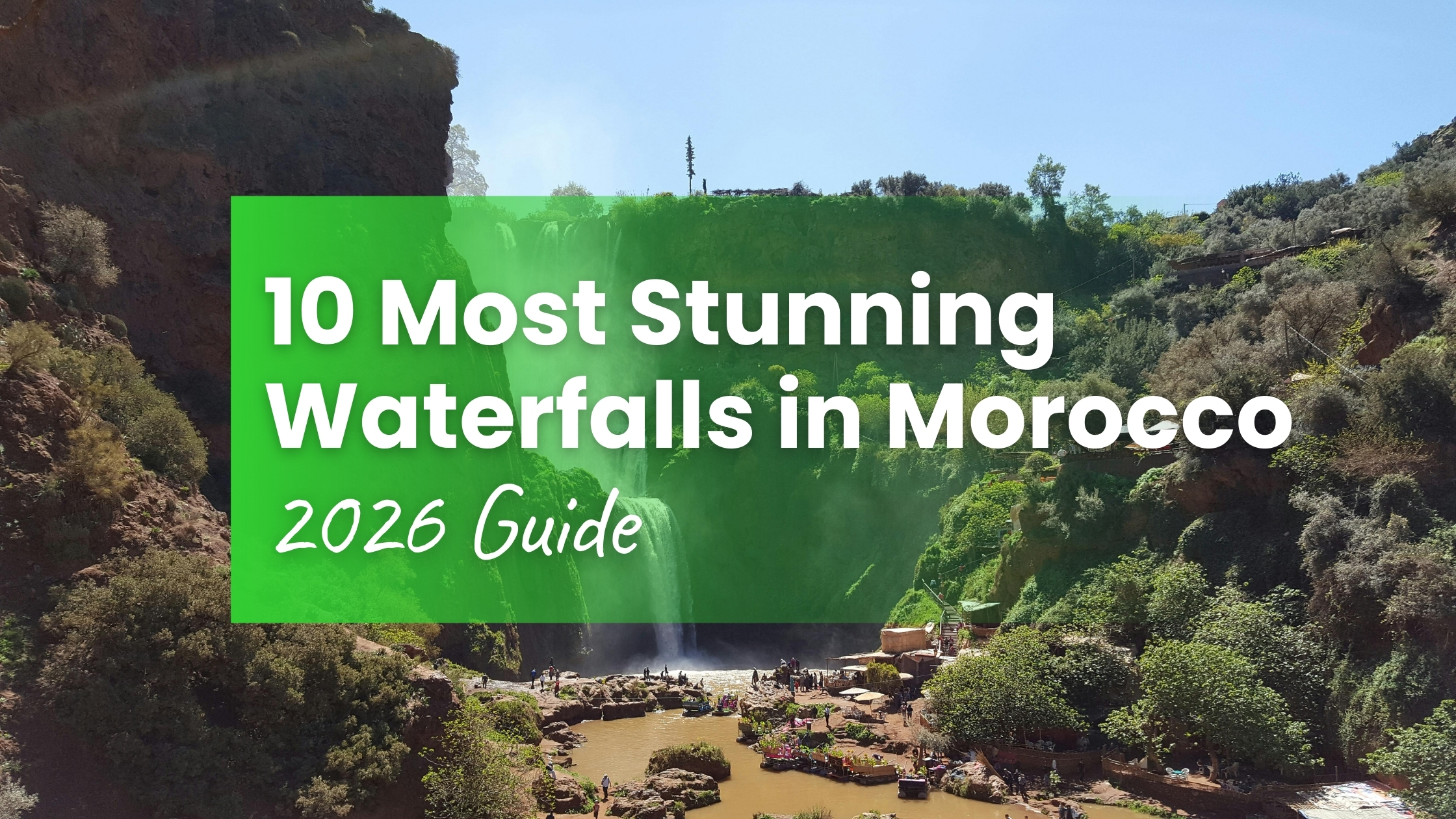
When most people think of Morocco, they picture the Sahara, the souks of Marrakech, or the blue-painted streets of Chefchaouen. Very few arrive expecting waterfalls. That gap between expectation and reality is exactly what makes discovering the waterfalls in Morocco such a genuinely thrilling experience. From the thundering 110-metre drop of Ouzoud in the Middle Atlas foothills to the hidden pink-granite canyons of the High Atlas, Morocco’s waterfalls are varied, dramatic, and — with the exception of Ouzoud on a public holiday — refreshingly uncrowded.
I have visited every waterfall on this list in person, most of them multiple times and across different seasons, and I can tell you plainly: Morocco’s natural waterfalls are among the most underrated travel experiences in North Africa. The country’s geography — multiple mountain ranges, Atlantic weather systems pushing moisture inland, and dozens of rivers cutting through ancient limestone and granite — creates ideal conditions for cascades of real power and beauty.
This guide covers the 10 best waterfalls in Morocco, with detailed directions, seasonal advice, hiking notes, and the kind of practical ground-level detail that only comes from actually being there. Whether you are planning a dedicated Morocco waterfall tour or simply want to add a natural highlight to an existing itinerary, this is the only guide you need.
Do Morocco’s Waterfalls Actually Impress?
This is a fair question, and one worth answering directly. Morocco is a predominantly arid country; roughly 85% of its land surface receives less than 400mm of rainfall annually. So how does a country so closely associated with desert landscapes produce genuinely impressive waterfalls in Morocco?
The answer is geology and geography working in combination. The High Atlas and Middle Atlas mountain ranges intercept Atlantic weather systems moving in from the northwest, forcing moist air upward where it cools and precipitates as rain and snow. Snowmelt from peaks above 3,000 metres feeds rivers through spring and early summer at volumes that would surprise any visitor expecting a trickle. The limestone and granite geology of both mountain ranges is ideal for dramatic cliff-face drops — Morocco’s waterfalls tend to plunge over resistant rock edges rather than cascading gradually, which gives them a verticality and power disproportionate to the size of the rivers feeding them.
The result is a country with waterfall experiences ranging from easy family-friendly strolls (Ouzoud, Setti Fatma’s first fall) to serious full-day mountain hikes (Akchour’s Grand Cascade, Ain Tissimane). The waterfalls in Morocco are real, they are beautiful, and they are well worth building a journey around.
| Waterfall | Region | Height | Difficulty | Best For |
| Ouzoud | Middle Atlas | 110m | Easy | Everyone |
| Akchour | Rif Mountains | 100m+ | Moderate | Hikers |
| Setti Fatma | High Atlas | ~30m | Easy–Mod | Families |
| Cascades d’Anou | High Atlas | 60m | Moderate | Off-trail seekers |
| Ain Tissimane | High Atlas | ~50m | Strenuous | Serious hikers |
| Imi n’Ifri | Middle Atlas | ~20m | Easy | Cave explorers |
| Ras El Oued | Middle Atlas | ~25m | Easy | Nature lovers |
| Oued Farda | Middle Atlas | ~15m | Easy | Day trippers |
| Aghbalou | Beni Mellal | ~40m | Easy | Local escape |
| Foum Kheneg | Draa Valley | ~20m | Easy–Mod | Desert contrast |
1. Cascades d’Ouzoud — The Undisputed King of Waterfalls in Morocco
No list of waterfalls in Morocco starts anywhere other than Ouzoud. The Cascades d’Ouzoud are the most visited, most photographed, and — by almost any objective measure — most spectacular of all Morocco’s natural waterfalls. Located approximately 150 kilometres northeast of Marrakech in the foothills of the Middle Atlas, the falls plunge 110 metres in three distinct tiers over a wide basalt face into a river gorge fringed with olive and pomegranate trees. The scale is extraordinary. Standing at the base with spray cooling your face and the sound filling every space around you, it is difficult to believe you are looking at a waterfall in Morocco rather than somewhere in sub-Saharan Africa.
The name ‘Ouzoud’ derives from the Tamazight word for ‘the act of grinding grain’ — and the old olive mills that gave the falls their name are still partially visible on the cliff face, some of them still operational during the olive harvest season. Troops of wild Barbary macaques patrol the rock ledges around the falls with a familiarity that suggests they regard the whole area as theirs, which in a meaningful sense it is. They have been here considerably longer than the restaurants and souvenir stalls.
The Morocco waterfall experience at Ouzoud rewards different levels of engagement. A first-time visitor can be at the base of the falls within 20 minutes of arriving at the parking area. A more serious visitor can spend half a day hiking the river gorge downstream, crossing the natural bridge, and swimming in the calmer pools above the main cascade. A small fleet of rowing boats operates below the falls, taking visitors into the spray for a few dirhams — it is a soaking experience and absolutely worth it.
Location & Getting There
Ouzoud lies in the province of Azilal, about 150 kilometres northeast of Marrakech and 160 kilometres south of Beni Mellal. There is no direct public transport from Marrakech; the most common approach is a grand taxi to Azilal town (2 hours, around 50 MAD per person), then an onward shared taxi to Ouzoud (30 minutes, 15 MAD). Most visitors from Marrakech book an organised day tour, which departs around 7:00–8:00 AM and costs 200–400 MAD per person in a group minibus. Private car hire from Marrakech costs around 800–1,200 MAD for the round trip.
Best Time to Visit
The waterfalls in Morocco are generally at their most powerful between February and May, when snowmelt from the Atlas ranges combines with winter and spring rainfall to swell all rivers significantly. Ouzoud in March or April is at its most dramatic — the falls run at full volume, the olive trees are in new leaf, and the gorge is green. Summer visits are perfectly viable but the falls run lower and crowds are heavier. Avoid Moroccan public holidays at all costs; the site becomes genuinely overwhelming.
Tips
Book your accommodation in the village of Ouzoud itself rather than doing it as a day trip if your schedule allows — waking up at the falls before the day visitors arrive and watching them in the morning mist is one of the best natural experiences in Morocco. Eat at the smaller restaurants halfway down the trail rather than at the top, where prices are inflated. Wear shoes you do not mind getting wet.
2. Akchour Waterfalls — The Jewel of the Rif Mountains
If Ouzoud is the most famous of the waterfalls in Morocco, Akchour is the most beautiful. Located in the Talassemtane National Park in the Rif Mountains, roughly 30 kilometres east of Chefchaouen, the Akchour waterfall system offers two distinct hikes from the same starting village: a shorter trail to the Pont de Dieu (God’s Bridge) natural arch, and a longer, more demanding ascent to the Grand Cascade. Both trails follow the turquoise Farda river through a gorge of extraordinary colour — the water here runs a mineral blue-green so vivid it looks digitally enhanced, set against walls of red and ochre rock draped in maidenhair fern.
The Grand Cascade, reached after a moderate two-hour climb from Akchour village, is the headline natural waterfall in Morocco for serious hikers. It drops roughly 100 metres in a single unbroken sheet over a smooth rock face into a deep plunge pool, surrounded on three sides by forested canyon walls. The trail to reach it is not technical, but it involves scrambling, river crossings on stepping stones, and a final steep approach — all entirely worth the effort.
Akchour receives far fewer international visitors than Ouzoud despite being, by any aesthetic measure, among the finest waterfalls in Morocco. This is partly because Chefchaouen itself absorbs most visitors’ time and attention. It is also because the hike requires genuine commitment. Both factors work in your favour if you make the effort.
Location & Getting There
From Chefchaouen, shared grands taxis run to Akchour village (25 minutes, around 15 MAD per person) from the main taxi station near Bab Onsar. The trail to the Pont de Dieu is a comfortable 45-minute walk; the Grand Cascade requires 2 to 2.5 hours of hiking. Local guides are available in the village and are worth hiring for the longer trail — 100–150 MAD per guide covers the full day.
Tips
Pack lunch and water — the single cafe at Akchour village is the only food option on the trail. Start early; the gorge trail gets direct afternoon sun and becomes hot. The waterfalls in Morocco’s Rif region run strongest in spring; summer visits to Akchour are still beautiful but the Grand Cascade drops to a fraction of its spring volume. Wear proper trail shoes — the river crossings are unavoidable.
3. Setti Fatma Waterfalls — The Ourika Valley Cascade Series
For visitors based in Marrakech, the Setti Fatma waterfalls in Morocco’s Ourika Valley are the most accessible of all the major cascade destinations. The village of Setti Fatma sits at 1,500 metres in the High Atlas foothills, 65 kilometres southeast of Marrakech, and serves as the trailhead for a series of seven waterfalls ascending the valley above the village. As natural waterfalls in Morocco go, Setti Fatma is more about cumulative charm than a single dramatic drop — no individual fall here matches the sheer scale of Ouzoud or Akchour, but the series as a whole, climbing through juniper forest and Berber farmland with the smell of wild herbs and woodsmoke in the air, is deeply satisfying.
The first waterfall is an easy 20-minute walk from the village, accessible to almost anyone including older visitors and families with children. The trail to the third and fourth falls (the most rewarding of the series) takes 45 to 60 minutes of moderate climbing over loose rock. By the time you reach the upper falls, you will have left the majority of visitors behind and found yourself in genuine mountain solitude — remarkable given that you are barely an hour from one of Africa’s most visited cities.
The waterfall trails at Setti Fatma are also notable for what surrounds them: the Ourika Valley is one of the most lush and productive agricultural landscapes in the Atlas region, and the walk passes through working Berber farms, irrigation channels carved from solid rock, and terraced fields of maize and barley. These waterfalls in Morocco are not experienced in isolation — they are embedded in a living cultural landscape, which gives them a richness that purely natural sites lack.
Location & Getting There
Grand taxis from Bab Rob in Marrakech run direct to Setti Fatma for 30–40 MAD per person in a shared vehicle. The journey takes around 1 to 1.5 hours depending on traffic. Private drivers charge 400–600 MAD for the round trip. The Monday souk in Setti Fatma makes that an especially rewarding day to visit.
Tips
Unofficial guides at the trailhead offer their services insistently but are not necessary for the lower falls. For the upper falls (fifth through seventh), a guide is genuinely useful for route-finding and worth the 50–80 MAD they charge. Bring water and snacks; the restaurant terraces along the river serve good tagines but close early in the afternoon.
4. Cascades d’Anou — Morocco’s Best-Kept Waterfall Secret
Of all the natural waterfalls in Morocco covered in this guide, Cascades d’Anou is the one that inspires the strongest reaction from the small number of people who have found it. Located in the Atlas foothills near the village of Tafza, roughly 80 kilometres southeast of Marrakech, it is a 60-metre waterfall dropping through a narrow canyon of pink granite that has been polished by the river into shapes of almost sculptural perfection. The trail following the river to the base of the falls passes through walnut groves, past Berber farms where women collect water from stone-lined channels, and through a series of smaller cascade pools where you can swim in complete isolation.
What distinguishes this Morocco waterfall from the others on this list is not just its beauty but its complete absence from the standard tourist circuit. I have visited Cascades d’Anou twice and seen no other foreign tourists on either occasion — only local Moroccan families on weekends and the occasional Berber farmer crossing the valley. The trailhead is unsigned in any language, the path requires local knowledge to follow correctly, and no group tours run here. All of this, of course, is precisely why it belongs on any serious list of the best waterfalls in Morocco.
Location & Getting There
Near the village of Tafza on the road between Marrakech and Ouarzazate, approximately 80 kilometres southeast of Marrakech. This waterfall in Morocco requires either a local guide (ask at any tour operator in Marrakech — expect to pay 300–400 MAD for a private guided excursion) or very specific GPS coordinates. There is no public transport to the trailhead.
Tips
This is a half-day hike minimum from the village. Combine with the Ait Benhaddou excursion if driving south on the Tichka route — the detour adds 90 minutes to the day and is worth every minute for anyone serious about Morocco’s waterfalls.
5. Ain Tissimane Waterfalls — Remote Beauty in the High Atlas
Ain Tissimane is among the most remote and physically demanding of all the waterfalls in Morocco, and it rewards that commitment with scenery that very few travellers ever see. Located deep in the Aït Bougmez Valley — the so-called ‘Happy Valley’ of the High Atlas, reached via a long mountain road from Azilal — the Ain Tissimane waterfall drops approximately 50 metres through a series of terraced pools above the treeline, surrounded by rocky alpine meadows at around 2,200 metres elevation.
Getting here requires a dedicated day or an overnight stay in the valley. The Aït Bougmez itself is one of the most beautiful and least-visited valleys in the Moroccan Atlas — wide, green, and lined with flat-roofed Berber granaries (agadirs) that look entirely unchanged from centuries past. The waterfall sits above the village of Aït Ali n’Ito and is reached by a two-hour walk from the valley floor. This is not a waterfall in Morocco for casual day trippers; it is for travellers with genuine interest in high-altitude landscape and cultural immersion.
Location & Getting There
The Aït Bougmez Valley is accessed from Azilal town, which lies about 170 kilometres from Marrakech. From Azilal, a shared taxi serves the valley road to the main village of Tabant (1.5 hours on rough road). The waterfall trail begins above Aït Ali n’Ito village. A local guide from the valley is essential — hire one through the Tabant guides association for around 300 MAD per day.
6. Imi n’Ifri Gorge and Waterfall — Nature’s Cathedral
Imi n’Ifri (meaning ‘mouth of the cave’ in Tamazight) near the town of Demnate is the most architecturally dramatic of all the natural waterfalls in Morocco — less a conventional waterfall than a geological theatre. A natural limestone arch spans a deep gorge above a seasonal waterfall, beneath which the river disappears entirely into an underground cave system. In spring, when the waterfall in Morocco’s Middle Atlas is at full flow, the sight of water vanishing into the earth beneath a 40-metre natural bridge, while hundreds of Alpine swifts spiral overhead, is genuinely breathtaking.
The guided gorge walk through Imi n’Ifri takes about two hours, passing through chambers where the rock overhead narrows to a slot of sky 50 metres above and bats hang in clusters from the ceiling. The ‘waterfall’ aspect is seasonal — visit between January and May for water; outside this window the gorge is dry but still spectacular as a geological formation. Combine with the Demnate Saturday pottery market for a full day.
Location & Getting There
Demnate lies 110 kilometres east of Marrakech on the road toward Azilal. The natural bridge and waterfall are 8 kilometres beyond Demnate on a rough track — a local guide or driver from Demnate is needed. Grand taxis run from Marrakech to Demnate in around 1.5 hours. Entry to the gorge is free; a local guide costs around 80–100 MAD.
7. Cascades de Ras El Oued — Middle Atlas Hidden Falls
The Cascades de Ras El Oued near the town of El Ksiba in the Middle Atlas are among the least-known waterfalls in Morocco despite being genuinely impressive and very easily accessible. The falls drop about 25 metres over a wide basalt step into a deep natural pool surrounded by cedar and oak forest. Unlike the Atlas mountain waterfalls further south, Ras El Oued sits in a forested landscape with a distinctly European atmosphere — cooler, greener, and shadier than the High Atlas. Local Moroccan families use the pool as a swimming destination in summer, which makes it a lively and welcoming scene on weekends.
This waterfall in Morocco is best combined with a broader Middle Atlas itinerary that includes the cedar forests of Azrou, the Barbary macaques of Ifrane National Park, and the town of Beni Mellal. As a standalone destination from Marrakech it is a long day; as part of a longer Morocco road trip it is a genuinely worthwhile stop.
Location & Getting There
El Ksiba lies about 180 kilometres northeast of Marrakech, roughly 30 kilometres northwest of Beni Mellal. Grand taxis run from Beni Mellal to El Ksiba. From El Ksiba, the falls are a 20-minute drive on a track passable by a standard car. A local guide from El Ksiba can walk you to the waterfall in 45 minutes.
8. Oued Farda Waterfalls — Sefrou’s Secret
The Oued Farda waterfall system near the historic town of Sefrou — 28 kilometres south of Fez — is one of the most conveniently located waterfalls in Morocco for visitors based in the north of the country. The Aggai River, which runs through Sefrou’s famous gorge, feeds a series of small cascades and pools just above the old medina that can be reached on foot in 15 minutes from the town centre. Sefrou itself is a severely underrated destination — a Jewish and Berber market town with a beautiful medina, a cherry orchard landscape, and a June cherry festival (Moussem des Cerises) that has been celebrated for over a century.
The waterfall in Morocco’s Sefrou gorge is modest in scale but exceptional in context — it runs through the living fabric of an old Moroccan town, with households built directly above the river and the sound of water audible from the medina’s alleyways. For travellers visiting Fez, a half-day trip to Sefrou combining the waterfalls, the medina, and lunch at one of the gorge-side restaurants is one of the most rewarding excursions in northern Morocco.
Location & Getting There
Grand taxis run frequently from Fez to Sefrou (40 minutes, around 15 MAD per person). The waterfall trail begins at the upper end of the medina, clearly signposted from the town centre. No guide is needed.
9. Cascades d’Aghbalou — The Beni Mellal Waterfall
Cascades d’Aghbalou (also known as Ain Asserdoun) just outside Beni Mellal is one of the most visited waterfalls in Morocco among domestic tourists but remains almost entirely unknown internationally. The spring-fed waterfall drops from the Jbel Tassemit escarpment directly above the town, and the area around it has been developed into a pleasant public garden with cafes, benches, and shaded terraces. The falls are modest — around 40 metres — but the setting, with the town of Beni Mellal spread below and the olive groves of the Tadla plain stretching to the horizon, makes this Morocco waterfall genuinely scenic.
This is an ideal stop on a road trip between Marrakech and Fez, or as a complement to the Ouzoud waterfalls excursion (Ouzoud and Aghbalou are about 50 kilometres apart and combine well in a single day with an early start).
Location & Getting There
The falls are 3 kilometres above central Beni Mellal, accessible by petit taxi from the town centre (10 MAD). Beni Mellal itself is served by regular buses and grand taxis from both Marrakech (2 hours, around 50 MAD) and Casablanca (3 hours). Entry to the garden area is free.
10. Foum Kheneg Gorge Falls — Draa Valley’s Surprise
The Foum Kheneg waterfall is the most unexpected entry on any list of waterfalls in Morocco — unexpected because it sits in the pre-Saharan Draa Valley, a landscape so dry that the presence of a significant waterfall feels almost impossible. In fact, Foum Kheneg is a slot canyon gorge fed by an intermittent river from the Jbel Saghro mountain range, and when it flows — primarily after winter rainfall between November and March — it drops through a series of narrow rock channels before pooling in a deep, sheltered basin surrounded by desert rock. The contrast between the ochre desert walls and the clear running water of this Morocco waterfall is visually extraordinary.
This is a destination for committed travellers. Foum Kheneg lies about 30 kilometres east of Agdz on rough piste tracks that require a 4×4 vehicle and local knowledge to navigate. But for anyone driving the Draa Valley between Ouarzazate and Zagora, the detour is one of those surprises that stays with you long after the more famous sights have faded.
Location & Getting There
East of Agdz in the Draa Valley, approximately 360 kilometres from Marrakech. A 4×4 vehicle is required from Agdz; local guides from Agdz or Zagora can arrange the excursion for around 500–700 MAD including the vehicle. This waterfall in Morocco is best visited as part of a longer southern Morocco road trip.
When Is the Best Time to Visit Waterfalls in Morocco?
The timing of your visit makes a profound difference to the Morocco waterfall experience. Understanding the seasonal rhythms is essential for setting the right expectations.
February to April — Peak Season for Waterfalls in Morocco
This is the prime window. Winter rainfall and Atlas snowmelt combine to push all of Morocco’s rivers to their annual maximum volume. The waterfalls in Morocco are at their most powerful, most photogenic, and most impressive during these months. Ouzoud in March runs at triple its summer volume. Akchour’s Grand Cascade is a genuinely formidable sight. Even the smaller falls — Setti Fatma’s upper series, the Imi n’Ifri gorge flow, Ras El Oued — run at full strength. The Atlas landscapes surrounding the waterfalls are also at their most beautiful: green, wildflower-covered, and alive with migratory birds stopping on the trans-Saharan route.
May to June — Transition Period
Snowmelt continues into May at higher elevations, keeping the Atlas waterfalls strong through late spring. By June, lower-elevation falls begin to drop off as temperatures rise and evaporation increases. Still a good time to visit the higher-altitude Morocco waterfalls like Ain Tissimane and Akchour.
July to September — Summer
All but the highest-elevation waterfalls in Morocco run at significantly reduced volume in summer. Ouzoud remains impressive year-round due to the volume of its source rivers, but most other falls are diminished. The upside: summer is the best time for swimming in the plunge pools, and crowds at the popular waterfall sites thin out on weekdays.
October to January — Autumn and Winter
Early autumn (October–November) sees the first rains returning and waterfalls gradually recovering. Winter is surprisingly rewarding for waterfall visits — the falls run well, the Atlas landscapes are dramatic under grey skies, and the complete absence of tourist crowds makes sites like Ouzoud and Setti Fatma feel entirely different from their spring incarnations.
How to Plan a Morocco Waterfall Tour
The waterfalls in Morocco are spread across three distinct mountain systems (High Atlas, Middle Atlas, Rif Mountains) and one pre-Saharan range (Jbel Saghro), which means a comprehensive Morocco waterfall tour requires planning around geography as much as individual sites.
A practical northern circuit covers the Rif Mountain waterfalls: base in Chefchaouen and day trip to Akchour and the Pont de Dieu, then head south to Sefrou for the Oued Farda gorge falls before continuing to Fez. This covers the best waterfalls in Morocco’s north in four to five days.
A central and southern circuit covers the Atlas falls: Marrakech as a base for Setti Fatma and Cascades d’Anou, then Azilal as an overnight stop for Ouzoud and the Aït Bougmez Valley (Ain Tissimane), and Beni Mellal for the Aghbalou cascade and Ras El Oued. Add Imi n’Ifri as a half-day detour from the Marrakech–Azilal road.
The Foum Kheneg falls in the Draa Valley are best incorporated into a broader southern Morocco road trip via Ouarzazate and Zagora rather than visited as a standalone excursion.
Pro Tip: If you can only visit one waterfall in Morocco, make it Ouzoud — it offers the best combination of accessibility, scale, and overall experience. If you can visit two, add Akchour for a completely different character and a harder but more rewarding hike.
What to Pack for Waterfall Hikes in Morocco
Morocco’s waterfall trails range from paved tourist paths to unmarked mountain routes, so packing appropriately depends on which falls you are visiting. These essentials apply to all waterfall hikes in Morocco:
Trail shoes or waterproof hiking boots — river crossings are common at Akchour, Setti Fatma upper falls, and Cascades d’Anou
A dry bag or waterproof phone case — spray is significant at Ouzoud’s base even from a distance
1.5–2 litres of water per person — springs along Atlas trails are not reliably safe to drink without treatment
Sun protection — above 1,500 metres the UV index is significantly higher than at sea level
A light layer for mountain waterfalls — Ain Tissimane and upper Setti Fatma can be genuinely cold even in summer
Cash in dirhams — no waterfall site in Morocco accepts card payment for guides, entry, or food
A change of clothes if visiting Ouzoud — the boat ride under the falls guarantees a thorough soaking
FAQ: Waterfalls in Morocco
What is the most famous waterfall in Morocco?
Cascades d’Ouzoud is by far the most famous waterfall in Morocco. At 110 metres and fed by substantial Atlas rivers, it is the largest and most visited of all Morocco’s natural waterfalls. It is accessible from Marrakech as a day trip and offers everything from easy walks to river gorge hikes and boat rides under the spray.
Are there waterfalls near Marrakech?
Yes — several of the best waterfalls in Morocco are within easy reach of Marrakech. The Setti Fatma waterfalls in the Ourika Valley are just 65 kilometres away and reachable in under 1.5 hours. Cascades d’Anou near Tafza are 80 kilometres southeast. Ouzoud, at 150 kilometres, is the furthest of the Marrakech-accessible waterfalls but the most spectacular.
Are there waterfalls near Chefchaouen?
Yes — the Akchour waterfalls are 30 kilometres east of Chefchaouen and among the most beautiful natural waterfalls in Morocco. The Grand Cascade and the Pont de Dieu natural arch are both accessible on hiking trails from Akchour village. Shared grands taxis run from Chefchaouen to the trailhead.
Can you swim at Morocco’s waterfalls?
At most of the waterfalls in Morocco, yes. The plunge pool at Ouzoud is swimmable in summer. The river pools below Akchour are excellent for swimming and snorkelling. The upper falls at Setti Fatma have shaded pools ideal for cooling off in warm weather. Swimming is generally safe; use common sense around waterfall spray zones where currents can be unpredictable.
What is the best month to visit waterfalls in Morocco?
March and April are the best months for visiting waterfalls in Morocco. Winter and early spring rainfall, combined with Atlas snowmelt, brings all rivers to their annual peak volume. The waterfalls are most powerful, the surrounding landscapes are at their greenest, and temperatures at waterfall sites are comfortable for hiking. May is also excellent for higher-altitude falls.
Do I need a guide to visit waterfalls in Morocco?
For the major accessible waterfalls in Morocco — Ouzoud, Setti Fatma lower falls, Imi n’Ifri, Aghbalou — no guide is necessary. For Akchour’s Grand Cascade, a guide is useful for route-finding on the upper trail. For Cascades d’Anou, Ain Tissimane, and Foum Kheneg, a local guide is essential — these Morocco waterfalls are unsigned and off the standard tourist circuit.
Are Morocco’s waterfalls accessible year-round?
The major waterfalls in Morocco — Ouzoud, Akchour, Setti Fatma — are accessible year-round, though summer volumes are significantly lower. Some of the smaller and higher-altitude waterfalls in Morocco are seasonal: Imi n’Ifri runs only from January to May, and Foum Kheneg is intermittent after rainfall. Always check conditions before visiting remote waterfall sites.
Start Planning Your Morocco Waterfall Journey
The waterfalls in Morocco are one of the country’s great undiscovered travel experiences — undiscovered, at least, by the majority of international visitors who arrive expecting only desert and souks. The reality is a country of extraordinary natural variety, where a two-hour drive from Marrakech puts you at the foot of a 110-metre cascade surrounded by olive trees and wild macaques, and a morning hike from a blue-painted mountain village takes you to turquoise river pools in a canyon that looks like nothing else in North Africa.
My recommendation: anchor any visit to the waterfalls in Morocco around Ouzoud as your centrepiece, add Akchour if you are visiting the north, and seek out at least one of the lesser-known falls on this list — Cascades d’Anou, Ain Tissimane, or Foum Kheneg — for the experience of discovering a Morocco waterfall that genuinely feels like yours alone.